
On this page
Relying on subjective cues like poking meat with a finger, checking cooking juices, or slicing open a chicken breast to check for pinkness leads to inconsistent results and potential foodborne illness risks. Meat coloration is notoriously deceptive: chicken can remain pink near bone marrow even when thoroughly cooked, while ground beef can turn brown before reaching a safe thermal kill temperature.
A reliable digital food thermometer is the single most impactful kitchen tool for taking the guesswork out of roasting, grilling, air frying, and stovetop searing.
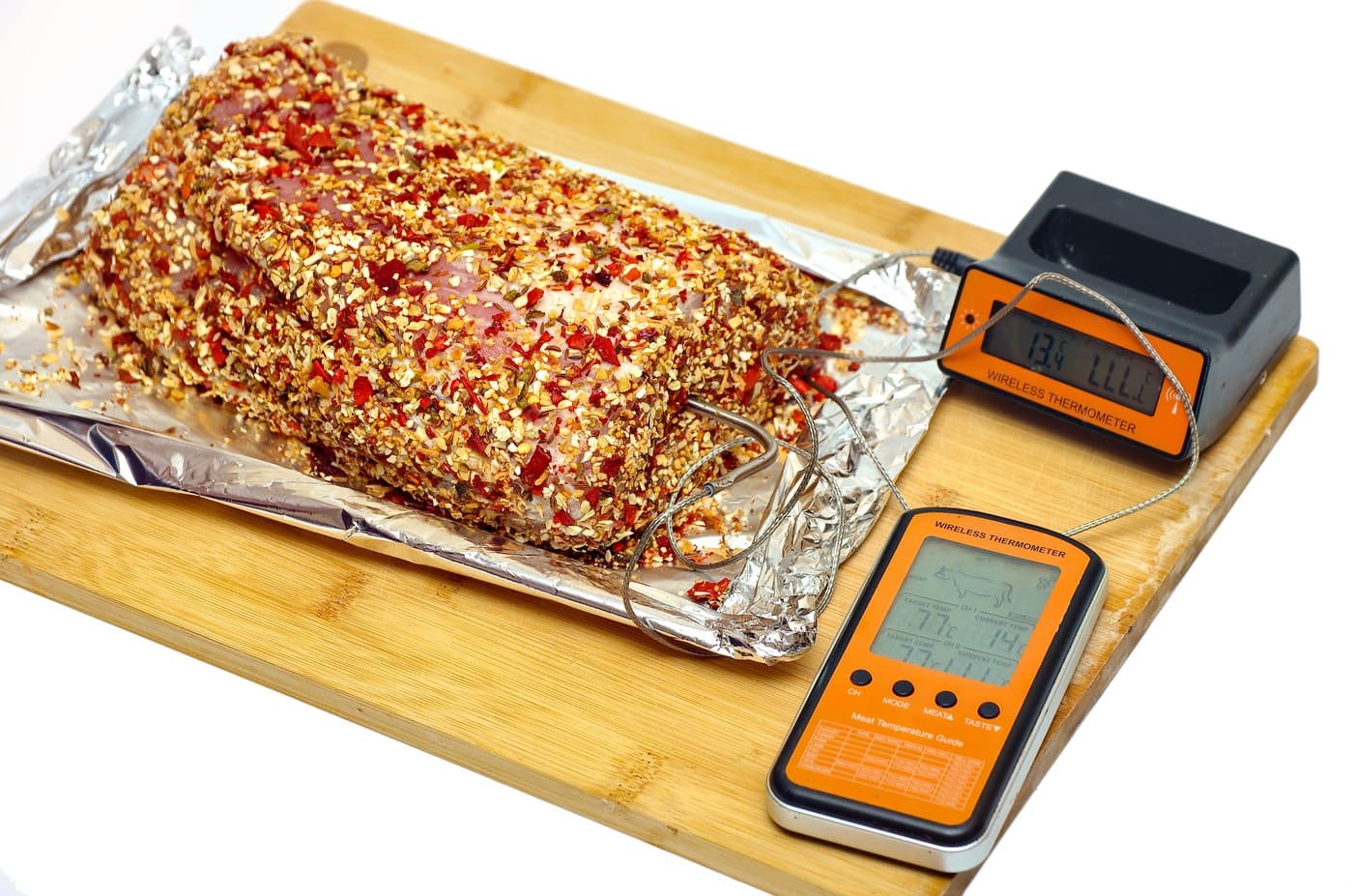
Instant-read vs leave-in probes: what is the difference?
Home cooks primarily choose between two distinct digital thermometer formats, each engineered for different stages of the cooking process.
| Feature | Instant-Read Thermometer (Handheld) | Leave-In Probe Thermometer (Wired / Wireless) |
|---|---|---|
| Primary Purpose | Spot-checking internal temperature during active cooking | Continuous real-time monitoring over long roasting or smoking sessions |
| Reading Speed | Ultra-fast (1 to 3 seconds) | Continuous tracking (updates every 1 to 5 seconds) |
| Probe Insertion | Inserted briefly for measurement and immediately removed | Stays embedded in the meat inside the oven, smoker, or grill |
| Sensor Placement | Micro-sensor located in the bottom 2 to 3 mm of the tip | Sensor located in probe tip; ambient sensor often built into probe shaft |
| Best Suited For | Steaks, chicken breasts, burger patties, fish fillets, baked bread | Whole turkey, bone-in pork roast, beef brisket, long barbecue cooks |
| Oven Safety | Never leave inside a hot cooking appliance | Probes and heat-rated cables are built to withstand 500°F+ (260°C) |
Understanding sensor technology: thermocouple vs thermistor
When shopping for an instant-read thermometer, you will encounter two primary internal sensor architectures:
1. Thermistor Sensors
- How They Work: Use an electrical resistor whose resistance varies predictably with temperature changes.
- Speed: Typically delivers stable readings within 3 to 6 seconds.
- Cost: Highly affordable, typically powering models in the $15 to $35 price bracket.
- Best For: Everyday home cooking, weeknight chicken bakes, and home baking where a 4-second read time is perfectly acceptable.
2. Thermocouple Sensors
- How They Work: Join two dissimilar metals at the probe tip, generating a micro-voltage proportional to temperature differentials.
- Speed: Extremely rapid, providing precision readings in 1 to 2 seconds flat.
- Cost: Precision engineering places these units in the $60 to $105 price tier.
- Best For: Professional kitchens, pitmasters, and home cooks searing over high-heat flames where holding your hand over a 600°F grill requires maximum speed.
Essential safe minimum internal temperatures
Cooking proteins safely requires reaching target internal temperatures that destroy common pathogens like Salmonella, Campylobacter, and E. coli.
| Meat / Poultry Category | Safe Minimum Internal Temp | Recommended Rest Time | Culinary Doneness Notes |
|---|---|---|---|
| All Poultry (Chicken, Turkey, Duck) | 165°F (74°C) | None required (5 min improves juiciness) | Measure in the thickest part of the breast and inner thigh; avoid bone contact |
| Ground Meats (Beef, Pork, Lamb) | 160°F (71°C) | None required | Ground meats mix surface bacteria throughout the meat; cook through thoroughly |
| Fresh Beef, Pork, Veal, Lamb (Steaks, Chops) | 145°F (63°C) | 3 minutes rest required | Medium doneness; resting allows carryover heat to complete pathogen destruction |
| Fish & Shellfish | 145°F (63°C) | None required | Flesh should be opaque and flake easily with a fork |
| Leftovers & Casseroles | 165°F (74°C) | None required | Reheat until steaming throughout |
How to take an accurate temperature reading
Even the most expensive thermometer produces deceptive readings if inserted incorrectly. Follow these fundamental probing rules:
- Aim for the Thermal Center: Insert the probe tip into the thickest section of the protein, equidistant from the exterior surface.
- Avoid Bone, Cartilage, and Fat Pockets: Bone conducts heat differently than dense muscle tissue, yielding artificially elevated temperature readings.
- Probe Horizontally on Thin Cuts: For burger patties, thin pork chops, or 1-inch salmon fillets, insert the probe horizontally from the side rather than down from the top. This ensures the entire sensor tip is enveloped by meat rather than passing through to the hot pan.
- Account for Carryover Cooking: Dense roasts and thick-cut steaks continue to rise by 3°F to 8°F during their 5 to 10-minute resting period on a cutting board as residual surface heat distributes toward the cooler core.
Buying advice: what features actually matter?
When evaluating models, look for these practical design details:
- Backlit Display with Auto-Rotating Orientation: Essential for reading digits in low-light evening grilling or awkward angles.
- IP65 or IP67 Waterproof Rating: Ensures the unit survives accidental splashes and can be safely washed under running tap water without fogging the display.
- Thin, Stepped Probe Tip: Probes tapering down to 1.6 mm pierce delicate cuts without releasing valuable meat juices or tearing flaky fish.
- Auto-Wake and Sleep Sensors: Extends battery life by powering the device down when folded or resting flat on the counter.
Sources
- United States Department of Agriculture (USDA-FSIS) — Safe Minimum Internal Temperature Chart & Guidelines — USDA Food Safety (opens in a new tab)
- U.S. Food & Drug Administration (FDA) — Food Code Temperature Monitoring and Food Contact Equipment Standards — FDA Food Code (opens in a new tab)
- National Institute of Standards and Technology (NIST) — Temperature Sensor Calibration Standards (NIST SP 250) — NIST Metrology Resources (opens in a new tab)